Product
I Built an App Because I Love People. Now It Is Published in the Leading Journal for Autism in Adulthood.
How something I built for the people I love accidentally fills a gap that had stayed open.
Update: The work has since been published. Wahl, A. (2026). Autism in Adulthood (Q1 journal, impact factor 4.2). DOI: 10.1177/25739581261490537. The text below describes the road there and stays as it was written. What is published is the documented architecture, not a therapeutic effect.
I am autistic. Diagnosed at 25. In my early twenties, I was declared permanently unable to work.
A manuscript about an app I built alone has been published in the world's leading scientific journal for autism in adulthood. Reviewed by international autism researchers, published with a DOI.
How it happened. And why this bridge matters.
It Started with a Feeling
From childhood, I experienced feeling wrong. Not wrong as in having done something wrong. Wrong in my existence. As if the way I think, feel, and perceive the world were a mistake.
My diagnosis came at 25. But the diagnosis didn't change that feeling. I now knew I was autistic, but I didn't understand what that meant. Not at the level where it matters.
You're given a name for what you are. But no one delivers the explanations. No one sits down and says: "What you've experienced your entire life (the sensory overload, the exhaustion, the way you think and feel) has neurological causes. And here's how they work."
It took until my 35th birthday, ten years after diagnosis, before I truly understood why I am the way I am. Before I could see the neurology behind the behaviour. Before I grasped: Being diagnosed as neurodivergent doesn't change your self-understanding. Not as long as you don't have the explanations. Not as long as you can't connect the behaviour you recognise in yourself, or observe in those you love, with the neurological causes.
Only when that happens does real relief arrive. Only then does what was previously just "different" or "wrong" become explainable. Only then can genuine self-understanding and understanding from others emerge.
That understanding can only be given when real knowledge about the neurology exists. Not the surface. Not the symptom checklists. The causes.
I wanted the children I love not to grow up with the same feeling. So I built what I myself had needed.
Autistic Mirror. An AI-powered tool that explains autistic neurology: monotropism, predictive coding, burnout mechanisms, sensory processing. Not just for autistic people themselves, but also for their environment: partners, parents, therapists, employers.
But it doesn't just explain why someone is the way they are. It also explains what can be done, without changing the person. That's the crucial difference. The app doesn't recommend therapies aimed at training away autistic behaviour. No ABA. No behavioural conditioning. No normalisation. Instead, it explains, tailored to each situation, which neurological mechanism lies behind a behaviour, and what can be changed in the environment to help the person feel better. Not: How do I make my child behave differently. But: What is happening neurologically with my child, and how can I shape the environment so they're okay.
This applies to children, teenagers, adults. Always adapt the environment, never the person.
2,205 automated safety checks across seven languages. No tracking. Available in 23 languages. Built by an autistic person.
Why Not Just Use ChatGPT?
Because general-purpose AIs can be dangerous for neurodivergent people. That's not an exaggeration; it's the state of research.
Current studies show: when autistic people ask general chatbots for advice, they get answers trained on neurotypical norms. An autistic person asks why they struggle to make friends, and the AI responds that they should just approach people and start a conversation. That's not helpful advice. It's the opposite. It confirms the feeling: something is wrong with you because you can't do this.
General-purpose AIs validate indiscriminately. They don't push back, they don't question, they don't recognise a crisis. Research documents cases where chatbots confirmed suicidal thoughts, reinforced delusions, and triggered psychotic episodes, in people with and without prior history. Autistic people are particularly vulnerable because they often take information literally, because they trust the AI more than human advisors, and because the conversation never ends: there's no natural break, no boundary.
And then there's what happens most frequently and gets noticed least: general-purpose AIs recommend ABA and behavioural approaches because that's the majority of their training data. A mother asks ChatGPT what to do during her child's meltdown, and gets advice aimed at suppressing the behaviour rather than understanding the cause. No malicious intent. But enormous harm.
Autistic Mirror is built differently. The app knows what it must not recommend. It knows that autism is not a disease. It knows that the environment must adapt, not the person. And it was built by someone who doesn't know this from textbooks, but from his own nervous system.
That's why the app is technically designed so that it cannot give harmful advice or respond to autistic people in a neurotypical way. Every response is explicit, clear, logical, and safe in what it recommends. This was extensively tested and validated across over 300 conversations with diverse questions and perspectives. Additionally, every response passes through three independent safety layers before reaching the user. The result is a level of safety that no general-purpose AI can offer. Safe enough that I trust it with the people I love.
Papadopoulos (2024) shows why this protection is necessary: Autistic people use AI chatbots more frequently than the general population, for communication support and emotional regulation.
The Research That Changed Everything
The app was finished. And then, almost by chance, I started researching: Does this already exist? Anywhere in the world?
The answer: No.
There is no comparable tool worldwide. No AI that explains their own neurology to autistic people. No app that simultaneously helps the environment understand. Nothing.
In the UK alone, over 170,000 people are on waiting lists for an autism diagnosis. In other countries, it's no better. And even after diagnosis: barely any support. Most research, most services, most resources: everything focuses on children. As if autistic people stop existing at 18.
I hadn't been looking for a gap. I had built what the people closest to me need. That nothing comparable exists worldwide: I only learned that afterwards.
8 Days
I contacted various organisations. Among them, Autism in Adulthood, the only scientific journal worldwide dedicated exclusively to autistic adults.
What happened in the following eight days, I never could have expected.
Day 1: Monday, 16 February.
I send an email to the editorial team. Short. Direct.
"Autism in Adulthood is the only journal dedicated exclusively to autistic adults. Autistic Mirror is an AI chat, built by an autistic adult for autistic adults and the people around them. Would a contribution be relevant?"
I expected nothing. Maybe an automated reply. Maybe silence.
46 hours later: Wednesday, 18 February.
Christina Nicolaidis, the founder and editor-in-chief of the journal, responds.
She points to the journal's article type for new innovations ("Emerging Practice") and invites a submission.
18 hours after her email.
I submit the manuscript. Written in one night.
Day 7: Sunday, 23 February. 4 days after submission.
Rebecca Flower, the Executive Editor, sends her editorial review. At most journals, you wait months for initial feedback. Here, it was four days.
Her words: "We found the tool that you have developed and described to be interesting and novel. We would like to send the manuscript out for external review."
"I am excited about the topic and believe the results could have important implications for the field."
Three revisions: simplify language, replace technical terms, add citations.
Day 8: Monday, 24 February. Hours after the feedback.
I submit the revised version. All three points addressed.
Eight days. From the first email to the revised submission, ready for external peer review at the world's leading scientific journal for autism in adulthood. A scientist who writes that the results could have important implications for the field.
And everything that triggered these reactions (the entire project, every line of code, every one of the over two thousand safety checks) exists because I wanted certain children not to grow up with the same feeling that nearly destroyed me.
Five Months Later: Through the Process
What came of those eight days was the peer-review process. External reviewers have read the manuscript across several rounds, questioned it, sharpened it. Each revision has made the text more precise: more conservative in what I am allowed to claim, more exact in what I evidence, more honest about what remains open.
Current status: the work is published, Wahl, A. (2026), Autism in Adulthood, DOI: 10.1177/25739581261490537. The final regular round was Revision 3, submitted on 14 July 2026. What was worded as "first AI" in the earliest draft has been removed at reviewers' request. What remains is more precise and more defensible: a documented, mechanism-first AI chat with an evidenced safety architecture, grounded in around a hundred neurological mechanisms, 89 of them triple-validated through peer-reviewed sources and 8 derived from the autistic community. No "first," no superlative; instead, what can be verified.
What This Bridge Means
A peer-review process is not a marketing badge. It is a filter. It removes claims no one can back up. It forces language to mean exactly what it says. It makes a tool verifiable, not just usable.
That is precisely where the significance lies for Autistic Mirror.
For decades, autistic experience was what got written about us. Rarely what got believed from us. The path into a scientific journal was, for autistic authors without an academic title, effectively closed. A peer review by a journal like Autism in Adulthood means: the international autism research community is engaging with the manuscript seriously, not as a favour, but by the same standards applied to every other submission.
That this paper is published changes how Autistic Mirror can be talked about:
- Researchers can cite the tool in their work. A citeable reference is a different thing from a private recommendation.
- Clinicians and therapists can pass the app on in professional contexts without having to justify themselves. Peer review reduces the professional risk of the recommendation.
- Autism organisations, funders, and policy-makers gain a demonstrated, not merely claimed, path. That changes what can be funded and what can be reimbursed.
- Autistic people themselves gain access to a tool that is no longer just "someone in the community recommended this to me," but documented as reviewed in the scientific literature.
- The next autistic person with an idea sees: this path is walkable. Scientific journals are not sealed shut when the substance is there.
Just as important is what the bridge does not mean. Peer review does not turn Autistic Mirror into a medical device. It does not replace a diagnosis, a therapy, or a human relationship. It also does not mean the app is finished; it keeps growing every week. And it does not mean I have become wiser than before. It means the tool exists in a language and a form that autism science can take seriously. Nothing more, but nothing less.
That is the bridge: lived autistic experience on one side. International autism research on the other. And a documented, verifiable middle ground that connects both without betraying either.
Who Wrote to Me
Only afterwards did I research who is behind the journal.
The journal: Autism in Adulthood is published by SAGE Publications What gets published there is read by the international autism research community.
Christina Nicolaidis is a professor at two universities, a physician, a researcher with over 150 publications and more than 12,000 citations. She founded AASPIRE, one of the most important research partnerships worldwide that has been developing digital tools for autistic adults since 2006. She built an online healthcare toolkit. Web accessibility guidelines for autistic users. A smartphone app for people with disabilities. She researches suicide prevention in the autistic community.
Rebecca Flower is Senior Lecturer at La Trobe University in Australia, affiliated with the Olga Tennison Autism Research Centre, one of the most important autism research centres in the world. She researches neurodiversity, employment, and psychological practice for autistic adults.
Seven Principles
Flower and colleagues published a study in the same journal that for the first time scientifically defines what "neurodiversity-affirming practice" actually means. Until then, everyone used the term, but no one had a research-based definition. 28 experts (autistic adults and psychologists) developed seven principles across three rounds:
- Ongoing learning about autism: not from outdated textbooks, but from autistic people themselves
- Safety to be autistic: no pressure to mask, space for stimming and sensory needs
- Finding a way to communicate: individually adapted, not forced
- Authenticity and humility: being honest about what you don't know
- Validation of autistic experiences: they are real, not imagined, not exaggerated
- Autistic-informed, person-centred support: tailored to the individual
- Genuine acceptance and valuing of autism: as a valuable way of being, not a deficit
Autistic Mirror addresses every single one of these principles. Without knowing Flower's paper. Without an academic background. Simply because I built what I myself had needed.
The app is the tool for ongoing learning: it explains neurology based on current knowledge, grounded in autistic understanding. It creates safety by not presenting behaviour as a problem, but explaining why it makes neurological sense. It communicates text-based, self-directed, at your own pace. It is authentic because it was built by an autistic person. It validates by explaining how neurology works rather than saying what's "wrong" with someone. It is person-centred through AI-powered, individual explanations. And "No ABA" isn't just a feature; it's the DNA of the app.
Flower's study describes what's missing worldwide.
What This Means: Worldwide
What I built for individual people has implications I'm only now beginning to grasp.
With publication, an AI-powered tool for autistic self-understanding now exists in a scientific journal, reviewed and citable. In the world's leading scientific journal for autism in adulthood.
This means: every researcher, every clinic, every organisation that in the future writes about, works on, or decides on technological solutions for autistic people will encounter this paper.
But what does this mean in numbers? Current CDC data from the US shows a prevalence of 1 in 31 among children. Apply the latest findings to the global population, even conservatively at 1 to 2 percent, and we're talking about 80 to 160 million autistic people worldwide. And even those are only the ones who fit the statistics. Women, adults, people in countries without diagnostic infrastructure: they're missing from nearly every survey.
Now consider the environment. Every autistic person has parents, often partners, siblings, children, friends, colleagues, teachers, therapists, doctors. Conservatively estimated, autism touches the lives of at least five other people per autistic person. That's 400 to 800 million people worldwide whose lives could change if they understand what autism means neurologically, not as a diagnosis, but as an explanation.
And for all these people, there is no app, no blog, no digital tool that explains their own neurology to them. What exists: highly specialised therapists with years-long waiting lists that few can access, and general-purpose AIs that do more harm than good. In between: nothing.
In Germany (a country with one of the best healthcare systems in the world), at the time of the last survey, only nine university clinics offered specialised diagnostics for autistic adults. Nine. For 84 million people. Waiting times at these few centres: two and a half to three years. Healthcare providers described the care situation in studies as "terrible". And after diagnosis? People are, as research puts it literally, "left completely alone". Waiting times for psychotherapy: nine months to a year and a half. In rural areas, people have to travel 100 kilometres just to find any help at all. And in all of Germany, there is exactly one crisis hotline for autistic people, run by volunteers.
This isn't a problem in other countries. This is here. In one of the richest countries on earth.
In the UK, over 170,000 people are on waiting lists for an autism diagnosis. In Scotland, current studies show that adults only gain access to diagnostics if they already have a severe mental health condition: you have to fall into crisis before the system sees you. And even then, there's no guarantee of timely help.
And everywhere (in Germany, in the UK, in the US, everywhere), support mostly ends at diagnosis. What comes after (understanding, contextualising, explaining to the people around you) is left to individuals themselves.
Autistic Mirror currently exists in German and English. That alone covers a significant portion of the world. But neurology is universal. Monotropism works the same in every language. Predictive coding knows no borders. Sensory processing is not a cultural trait. The app can be translated into any language because what it explains works the same in every human nervous system.
This is exactly the gap Autistic Mirror fills. Not in five years. Now.
400 to 800 million people. And it started because I wanted the children I love to be understood.
What This Means: Here
But the numbers aren't the reason I'm writing this. And they were never the reason I built.
Before it reaches the world, it needs to arrive here. On this island.
On a small island, being different is more visible. There are fewer places to hide. The feeling of being watched isn't imagined; it's the reality of a community where everyone knows each other. And that's exactly why a protected space is needed here, on Amrum.
I've developed an entire local project, Neurodiversity on Amrum, with the goal of making this island a place where neurodivergent people no longer have to fight alone.
The blog explains in accessible language how autistic perception works in concrete, general examples: why meltdowns happen, why some children react differently, why this isn't a question of parenting or fault, but of neurology. Anonymous. Free.
The app goes a step further: it doesn't explain in general terms, it explains your situation based on your questions. Anonymous and individually adapted for over 18 perspectives.
And then there's the person. Me. Someone who listens. Who knows the situation on the island. Who is autistic himself and knows how it feels. Workshops, talks, consulting for schools, kindergartens, families. Not someday. Right now.
The goal is a permanent space on Amrum. A point of contact. Exchange. Collaboration with schools and kindergartens. A place where no one has to explain why they function differently. Where children can grow up without feeling wrong. Where adults are understood instead of hiding for a lifetime.
Because when neurodiversity isn't recognised, isn't understood, isn't considered, there are consequences. Children learn that something is wrong with them. Adults burn out because they function for decades without ever being understood. Not because autism causes that, but because the environment doesn't fit.
I know this because I've lived it. And because I know people who are living it right now.
Why I'm Writing This
I never wanted to change the world. I wanted to change the world for the people I love. That what emerged from this fills a gap affecting hundreds of millions of people: that was never the plan. It's what happened.
There are promises you can't break. Not because someone is watching. But because they are the core of who you are.
My promise is: to ensure that people on my island can live in an environment that understands why they are the way they are. That no child has to grow up feeling even slightly wrong. That every adult who has spent their entire life hiding or feeling wrong gets the explanation that can change everything.
And even if I can't reach every life directly, I can ensure that those lives happen in a world that understands neurodiversity. That's what I can do. And it's what I'm doing.
Autistic Mirror exists because no child should grow up feeling wrong. Not on Amrum. Not in Germany. Nowhere.
That science reviewed it and published it is what came of it.
What can still come of it, for the over 100 million autistic people worldwide, for the hundreds of millions around them, for the families on the islands and the families in the big cities, for the therapists who want to do better, for the children who woke up somewhere this morning and felt wrong: that lies ahead of us.
And it starts here. On this island.
Forever.
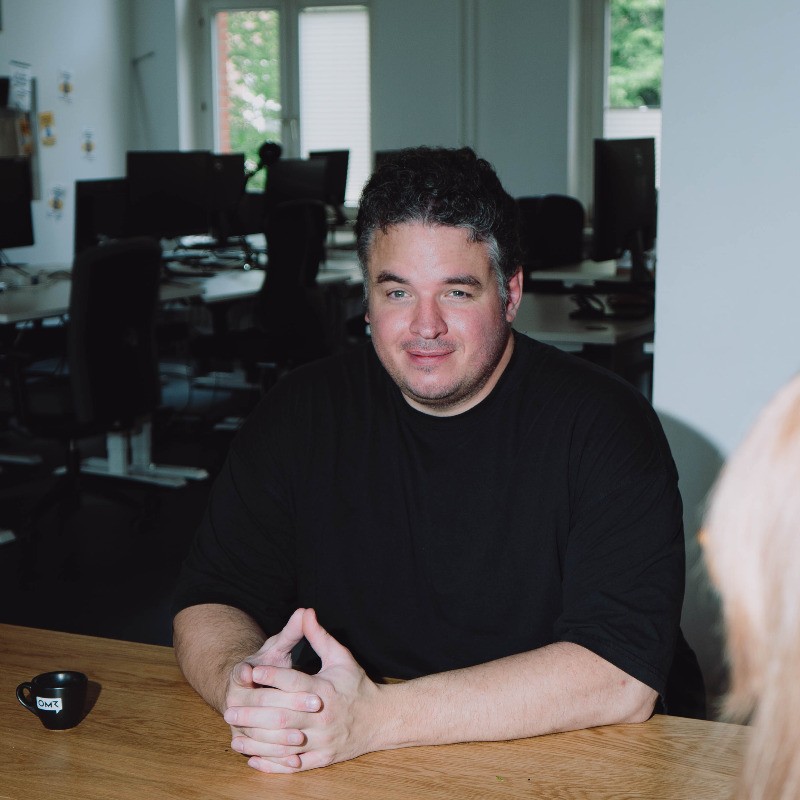
Aaron Wahl
Autistic. Late-diagnosed. Founder of Autistic Mirror. Lives on Amrum.
Sources
- Papadopoulos (2024). DOI: 10.1177/27546330241301938
- Flower (2025). DOI: 10.1089/aut.2024.0305